GPT-5.5 Review: Benchmarks, Pricing, Codex Impact, and Early Reactions (2026)
What changed in GPT-5.5, where it leads on agent benchmarks, why pricing looks 2x higher, and how Codex users should think about upgrading as of April 2026.

Quick take
Start with this judgment
28 min readBottom line
What changed in GPT-5.5, where it leads on agent benchmarks, why pricing looks 2x higher, and how Codex users should think about upgrading as of April 2026.
- Best for
- Readers comparing cost, capability, and real limits before choosing a tool
- What to check
- GPT-5.5 · OpenAI · AI model comparison
- Watch out
- Pricing and features can change, so confirm with the official source too.
3 key points
- GPT-5.5 is OpenAI’s latest frontier model, released on April 23, 2026, and is an update that brings coding agents, computer use, knowledge work, and scientific research to the forefront.
- Although it is strong in long-running agents such as Terminal-Bench 2.0 at 82.7%, OSWorld-Verified at 78.7%, and BrowseComp at 84.4%, SWE-Bench Pro is at 58.6%, which is lower than Claude Opus 4.7’s 64.3%.
- The API token unit price is twice that of GPT-5.4, but Artificial Analysis found that the actual index execution cost increase was only about 20% due to a 40% reduction in output tokens.
목차
- What exactly has changed in GPT-5.5?
- Where is GPT-5.5 stronger in the benchmark?
- Is the price really twice as expensive as GPT-5.4?
- Should Codex users switch to GPT-5.5 right now?
- Why are people’s reactions so different?
- Where do GPT-5.5 and Opus 4.7 diverge?
- What are the limitations and precautions?
- Which team should use it first?
- FAQ: Frequently asked questions about GPT-5.5?
- Conclusion: Is GPT-5.5 worth using now?
What exactly has changed in GPT-5.5?
To conclude, GPT-5.5 is closer to “A model that pushes the work to the end” than to “Models who are better at chatting.” OpenAI described GPT-5.5 as a model that sequentially performs code writing and debugging, online research, data analysis, document and spreadsheet creation, and software manipulation (Source: OpenAI GPT-5.5 Announcement). This is a release that focuses on planning, using tools, checking, and trying again without requiring users to constantly manage the detailed steps.
Release date and distribution scope
The official announcement date of OpenAI is April 23, 2026. In Korean time, it can be viewed as the latest public model as of April 24, 2026. In ChatGPT, GPT-5.5 Thinking is sequentially distributed to Plus, Pro, Business, and Enterprise users, and GPT-5.5 Pro is provided to Pro, Business, and Enterprise users. Codex provides Plus, Pro, Business, Enterprise, Edu, and Go plans and uses 400K contexts (Source: OpenAI GPT-5.5 Announcement).
There are also things to be careful about. The API price has been revealed, but OpenAI only said that it will soon provide GPT-5.5 and GPT-5.5 Pro for the Responses API and Chat Completions API. In other words, as of April 24, 2026, ChatGPT·Codex distribution and general API provision must be viewed separately.
How is its role different from GPT-5.4?
If GPT-5.4 was a “relatively affordable pro working model,” GPT-5.5 is a one-level expensive frontier work model. The OpenAI pricing page also lists GPT-5.5 as the new intelligence class for “coding and professional work,” leaving GPT-5.4 as the cheaper option (Source: OpenAI API Pricing).
판단 기준
GPT-5.5 should be viewed based on three criteria
Just saying things have improved is not enough. The real difference lies in the power of continuing execution, the power of holding on to long contexts, and how the cost per operation changes.
long run
It is the ability to push through a goal to the end by making multiple terminal, browser, and tool calls.
This is felt first in Codex and automation workflows.
long context
This is the ability to not lose necessary information even in long logs, documents, and code bases around 512K to 1M.
There is a difference between long document research and large repo analysis.
cost per task
The token price increases, but the actual cost of work changes as retries and output tokens decrease.
It is more accurate to compare actual work logs rather than price lists.
Why is it called “agent model”?
The message of GPT-5.5 is clear. It is not a model where you ask a question once and receive an answer, but rather an agent-type business model that handles multiple stages of work. TechCrunch also reported that OpenAI described GPT-5.5 as part of a super app strategy that combines ChatGPT, Codex, browser, and work automation (Source: TechCrunch).
This flow is also in line with the IDE-centered agent flow discussed in [Completely Conquering Claude Code] (/en/ai/claude-code-review). Model comparison is now moving from “Is your answer smart?” to “Can you use the tool to make actual changes?”
Where is GPT-5.5 stronger in the benchmark?
GPT-5.5’s strengths are most evident in terminal-based agents, web browsing, and long context searches. Conversely, in SWE-Bench Pro, which looks at actual GitHub issue resolution, Opus 4.7 is still ahead. So both “GPT-5.5 is the best” and “no difference” are half-interpretations.
판단 기준
Benchmarks should be read in groups of three, not as a single line ranking.
The key point of this update is not that all indicators have been won, but that the winning position has changed in certain business groups.
Terminal-Bench·OSWorld
This is an indicator to see whether the model continues actual behavior, such as terminal commands, GUI manipulation, and repeated verification.
GPT-5.5 is the axis that appears the strongest.
SWE-Bench Pro·MCP Atlas
We look at the ability to fix problems and enforce tool contracts in a real code base.
The defense of Opus 4.7 is still high.
MRCR·BrowseComp
It is the ability to find needle-like information in long documents and synthesize web data.
This is the area where GPT-5.5 jumped the most compared to GPT-5.4.
Coding: Terminal-Bench wins by a landslide, SWE-Bench Pro is ambiguous
In the OpenAI official table, GPT-5.5 recorded Terminal-Bench 2.0 82.7%. It is higher than GPT-5.4 75.1%, Claude Opus 4.7 69.4%, and Gemini 3.1 Pro 68.5%. This benchmark is an indicator of planning, iteration, and tool coordination in complex command line tasks, so it fits well with agent environments such as Codex (Source: OpenAI GPT-5.5 Announcement).
But SWE-Bench Pro is different. GPT-5.5 is 58.6%, GPT-5.4 is 57.7%, and Claude Opus 4.7 is 64.3%. It’s hard to say “1st place overall in coding”. Solving single PRs, fixing complex code base bugs, and real-service refactoring require a head-to-head comparison with Opus 4.7, which will be covered in the next article. The existing summary can be viewed first in [Claude Opus 4.7 summary] (/en/ai/claude-opus-4-7).
벤치마크 그래프
Coding benchmarks are divided into two branches.
GPT-5.5 is stronger for tasks that run for a long time in the terminal, and Opus 4.7 is still ahead when it comes to actually resolving GitHub issues.
Source: OpenAI GPT-5.5 announcement, Evaluations table
| benchmark | GPT-5.5 | GPT-5.4 | Claude Opus 4.7 | Gemini 3.1 Pro |
|---|---|---|---|---|
| SWE-Bench Pro | 58.6% | 57.7% | 64.3% | 54.2% |
| Terminal-Bench 2.0 | 82.7% | 75.1% | 69.4% | 68.5% |
| Expert-SWE (Internal) | 73.1% | 68.5% | - | - |
| OSWorld-Verified | 78.7% | 75.0% | 78.0% | - |
| BrowseComp | 84.4% | 82.7% | 79.3% | 85.9% |
| MCP Atlas | 75.3% | 70.6% | 79.1% | 78.2% |
| FrontierMath Tier 4 | 35.4% | 27.1% | 22.9% | 16.7% |
| MRCR 512K-1M | 74.0% | 36.6% | 32.2% | - |
Computer use and browsing: Getting closer to being a practical agent
OSWorld-Verified looks at the model’s ability to understand the screen and perform tasks in a real operating system environment. GPT-5.5 is 78.7%, slightly ahead of GPT-5.4’s 75.0% and Opus 4.7’s 78.0% (Source: OpenAI GPT-5.5 Announcement).
BrowseComp is focused on finding and synthesizing information on the web. The GPT-5.5 basic model is 84.4%, and the GPT-5.5 Pro is 90.1%. Opus 4.7 is 79.3%. In long-term research, data verification, and document creation-type tasks, GPT-5.5 is more persuasive. This point is also connected to How to reduce Claude Code tokens with Graphify. Even if the model’s long-reading ability improves, cost and accuracy can be further stabilized by using external memory and structured context.
벤치마크 그래프
Tool use and business indicators
When it comes to browsing, tool calling, and computer use, differences in strengths for each task are more important than the complete victory of a single model.
Source: OpenAI GPT-5.5 announcement, Professional·Computer use and vision·Tool use table
Long context: jumps are large around 1M
The most notable figure is OpenAI MRCR v2 8-needle 512K-1M. GPT-5.5 is 74.0%, GPT-5.4 is 36.6%, and Opus 4.7 is 32.2%. In a test that required finding multiple needle-like pieces of information in the same long document, GPT-5.5 showed a nearly double jump (Source: OpenAI GPT-5.5 Announcement).
This figure is the basis for the use case “Put entire large code bases in and ask questions.” Of course, in an actual repo, dependencies, build logs, test results, and the latest file status must be included, so benchmark scores should not be directly translated into actual success rates. Still, the level of improvement compared to GPT-5.4 in the 1M context section is the most obvious advantage of this update.
벤치마크 그래프
The gap is clearer between long contexts and difficult inferences.
The MRCR 512K~1M section is the point where GPT-5.5 widens GPT-5.4 and Opus 4.7.
Source: OpenAI GPT-5.5 announcement, Evaluations table
Is the price really twice as expensive as GPT-5.4?
That’s true if you look at the price per token. GPT-5.5 is twice as expensive as GPT-5.4 for both input and output. However, in agent work, “Total tokens it takes to complete one task” is more important than the price per token.
판단 기준
The cost of GPT-5.5 is more than just a price tag
The agent model's billing amount is determined by the unit price, output length, and number of retries after failure.
Input/output token price
GPT-5.5 has both input and output unit costs twice that of GPT-5.4. This difference is clearly visible in the short Q&A.
Output tokens per task
Completing the same work in less time can partially offset the increase in output costs. This is also the point that Artificial Analysis sees.
Retry and human review
As first-time pass rates increase, the time required to re-run tests, modify prompts, and human review also decreases.
Public API Pricing List
The OpenAI price page lists GPT-5.5 as “Coming soon” and suggests an input of $5.00, a cash input of $0.50, and an output of $30.00 based on 1 million tokens. GPT-5.4 costs $2.50 input, $0.25 cache input, and $15.00 output (Source: OpenAI API Pricing).
| model | Input/1M | Cache input / 1M | Output / 1M | situation |
|---|---|---|---|---|
| GPT-5.5 | $5.00 | $0.50 | $30.00 | Coming soon |
| GPT-5.5 Pro | $30.00 | - | $180.00 | Coming soon |
| GPT-5.4 | $2.50 | $0.25 | $15.00 | API provided |
| GPT-5.4 mini | $0.75 | $0.075 | $4.50 | API provided |
| Claude Opus 4.7 | $5.00 | Separate cache policy | $25.00 | API provided |
Here, GPT-5.5 Pro is in a completely different cost range. Output of $180 is a burdensome amount to spend on mass coding automation. It is correct to view it as a model that is limited to “Need to get hit one more time” tasks such as research, legal review, financial modeling, and scientific data interpretation where the cost of incorrect answers is high.
Double the unit price and the cost per job are different.
Artificial Analysis analyzed that although the price per token of GPT-5.5 is twice that of GPT-5.4, when running its own Intelligence Index, output token usage was reduced by about 40%, so the overall execution cost increase was only about 20% (Source: Artificial Analysis).
핵심 정리
The output cost changes like this:
The unit price is doubled, but as the number of output tokens decreases, the increase in cost per task varies. Below is a simplified calculation of one Codex operation.
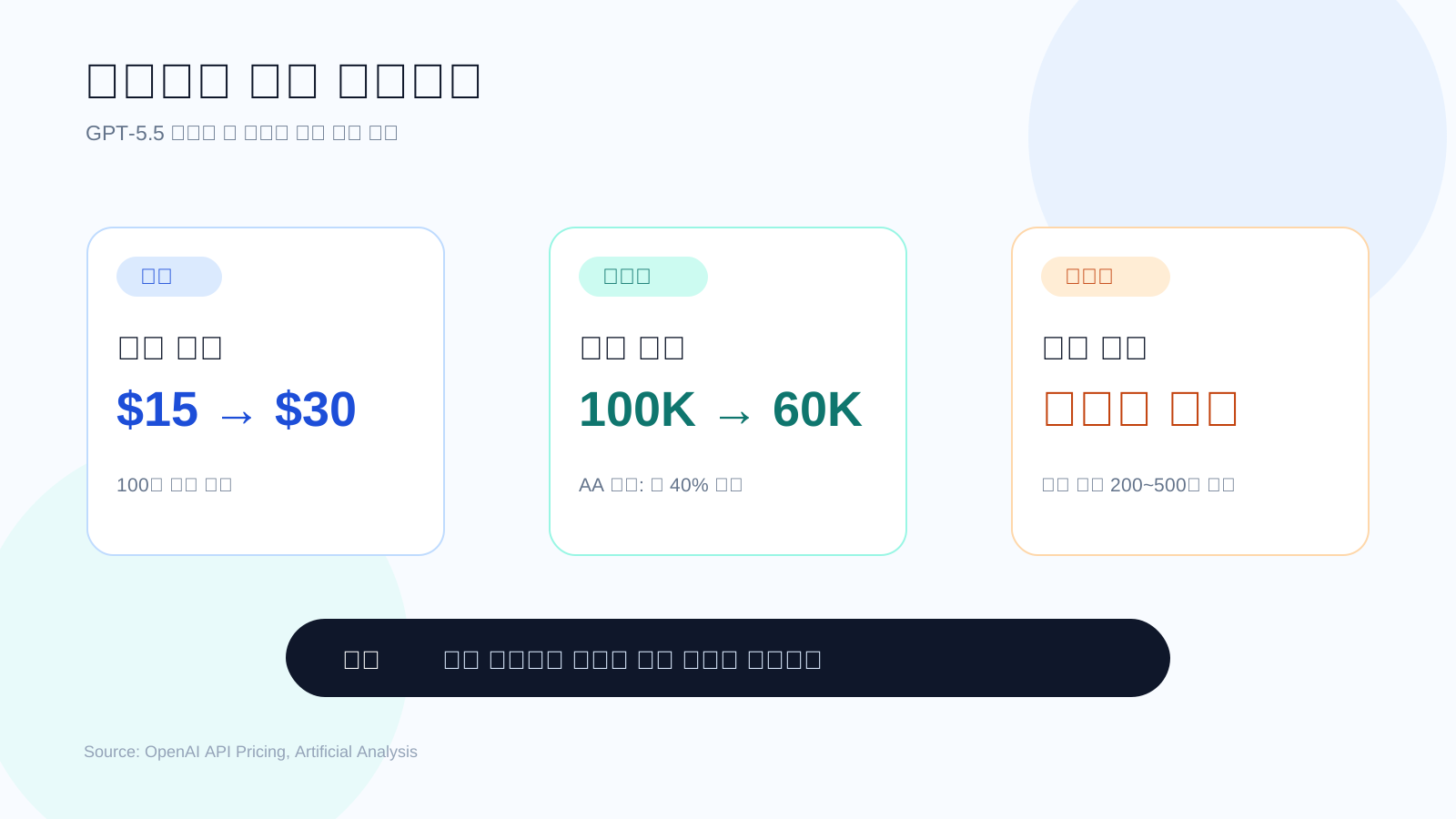
Things to watch out for when comparing costs
This calculation does not apply automatically to all users. Tasks that do not significantly reduce the output tokens, such as short questions, simple translations, and general chatting, may feel like they cost nearly twice as much. Conversely, in an agent loop where debugging, testing, browsing, and tool calls are repeated, costs are likely to be offset by reducing retries and lengthy intermediate explanations.
GPT-5.5 has definitely become more expensive in terms of token price. However, for agent-type tasks, the actual billing amount depends on token efficiency, number of retries after failure, prompt cache, and whether the Batch/Flex option is used. Before deployment, the safest method is to sample 200 to 500 existing GPT-5.4 logs and run the same task again.
Should Codex users switch to GPT-5.5 right now?
If you use Codex for business purposes, it is worth testing. However, rather than changing it to the default for all tasks, it is better to route from “Long-term tasks that use a lot of terminal”.
Codex tasks that fit well with GPT-5.5
OpenAI explains that GPT-5.5 has become stronger for engineering work from Codex to implementation, refactoring, debugging, testing, and verification (Source: OpenAI GPT-5.5 Announcement). The Terminal-Bench 2.0 scores also support this explanation.
It is especially good to experiment starting with the next task.
판단 기준
What to do first in Codex
Rather than changing it to the default for all tasks, it is better to narrowly test GPT-5.5 starting with loops that show its advantages.
Failure log-based cause tracking
This involves reading error logs, reproduction commands, and related files together to narrow down the cause.
Repeat shell commands and tests
It is a loop that runs build, test, and type check after modification, and repairs again if it fails.
Structural changes that touch multiple files
This is a task of coordinating the internal implementation and call section while maintaining the interface.
Self-check after implementation
This involves organizing a summary of changes, remaining risks, and reproducible verification results.
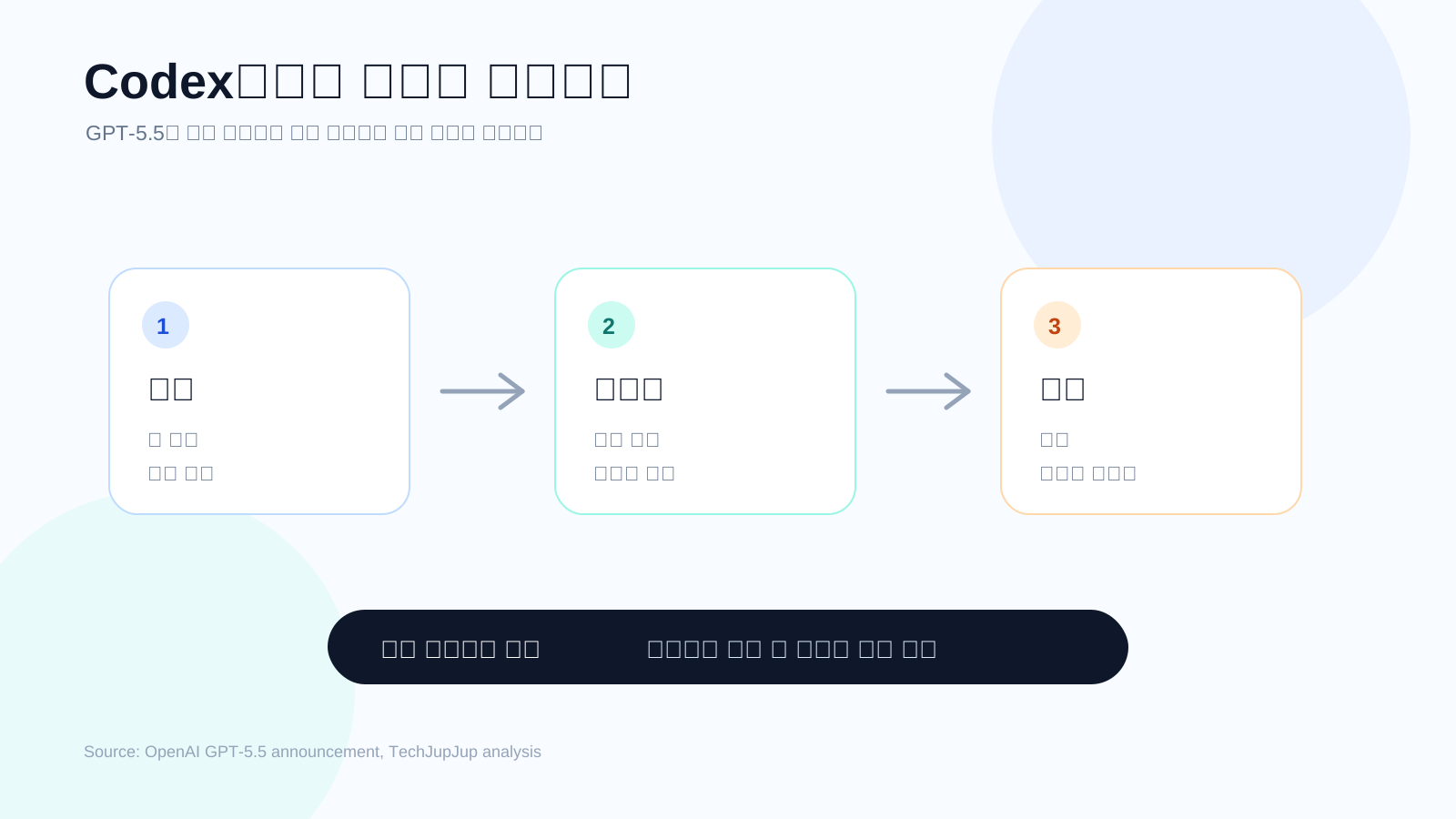
What CodeRabbit Early Tests Say
CodeRabbit reported improved code review signals in its initial testing of GPT-5.5. In the screening benchmark, the expected issue discovery rate increased to 79.2% vs. 58.3%, and precision increased to 40.6% vs. 27.9%, while on the larger test set, it achieved 65.0% vs. 55.0% and 13.2% vs. 11.6%, respectively (Source: CodeRabbit).
However, this is the vendor’s own workload. Rather than saying “All code reviews are 30% better,” it is correct to view this as evidence that signal quality is likely to improve in code review products. Still, the observation that GPT-5.5 is more robust against small changes, actual failure causes, and verification loops than lengthy rewrites is a pretty important signal for Codex users.
Who is High Speed Mode for?
OpenAI announced that Codex also provides GPT-5.5 fast mode. Token creation is 1.5 times faster but 2.5 times more expensive (Source: OpenAI GPT-5.5 Announcement). This mode is closer to “Reducing waiting time for long agent tasks” than to “Seeing the answer quickly.”
The recommendation criteria are simple.
판단 기준
Fast mode is a paid option that reduces waiting time
A fast model is not always a good model. You should first check whether there are people waiting, whether it is a background task, or whether there are budget constraints.
Local tasks waiting for people
There is tangible value in debugging and refactoring, where developers wait for results in front of the screen.
Background work that runs all night
If waiting time is less important, it makes sense to save money in normal mode.
Cost limits for Plus/Team accounts
Leaving high-speed mode as the default can cause your quotas and budget to run out faster than expected.
Why are people’s reactions so different?
Initial reactions were clearly divided. The positive side refers to “perceived intelligence,” “Short and direct task handling,” and “Agency in Codex.” The negative side says “It falls behind Opus 4.7 in SWE-Bench Pro”, “the price went up”, and “xhigh mode is slow, but the perceived improvement is not clear”. There are reasons for both.
Positive reaction: It feels different than the benchmark.
The OpenAI announcement included reactions from early testers, including Dan Shipper and Pietro Schirano. The key point is that GPT-5.5 understands the form of the system, the cause of failure, and the scope of surrounding influences better than simply writing code (Source: OpenAI GPT-5.5 Announcement).
There was also a response on Reddit r/singularity: “The benchmark improvement is smaller than expected, but the experience of conversation and explanation is different.” An early review of r/OpenAI also felt strongly about infrastructure and workflow issues, but cited the habit of predicting actions instead of actual actions and the delay of xhigh mode as disadvantages (Source: r/singularity, r/OpenAI).
Negative reaction: I see areas where Opus cannot be defeated.
The r/codex release thread immediately talked about SWE-Bench Pro. It is pointed out that GPT-5.5 is 58.6%, but Opus 4.7 is 64.3% (Source: r/codex). This criticism is valid. “Agent-type coding” that OpenAI talks about and “Ability to fix actual PR at once” that users expect are not exactly the same indicators.
The price reaction is also similar. A response was posted on r/OpenAI that the GPT-5.5 API is twice as expensive as GPT-5.4 (Source: r/OpenAI). The token efficiency claims made by OpenAI and Artificial Analysis are important, but if users focus on short chats or simple API calls, the experience may be closer to “It just got expensive.”
- "Responses to being more direct and less verbose in real-life business problems" — CodeRabbit, r/OpenAI
- "Responses to generational differences in long contexts and terminal operations" — OpenAI announced, r/singularity
- "Codex reacts better to small changes and verification loops" — CodeRabbit
- "The response was that it did not exceed Opus 4.7 based on SWE-Bench Pro." — r/codex
- "The reaction is that the API unit price will be doubled first." — r/OpenAI
- "Initial reviews say that xhigh mode is slow but the perceived improvement is not clear." — r/OpenAI
How to read reactions now
Community response is not a benchmark. In particular, the response on the day of launch is a mix of account rollout, plan limitations, UI status, prompt habits, and expectations compared to previous models. So, in this article, I only see the response as a hint of “Where do users find value?”
To summarize, it is like this. GPT-5.5 is not an all-purpose model that will immediately impress you, but rather a model that gradually shows differences in tasks that are left to you over a long period of time. Conversely, just looking at a short question and a single code patch can easily lead to a response like “Why has this become so expensive?”
Where do GPT-5.5 and Opus 4.7 diverge?
The subject of the next article is this comparison. Here, let’s just draw the conclusion first. GPT-5.5 is strong in terminal, browsing, long context, and cost-effectiveness, while Opus 4.7 is strong in SWE-Bench Pro, MCP Atlas, high-density code review, and self-verification.
GPT-5.5 is advantageous
Areas where GPT-5.5 is clearly ahead are Terminal-Bench 2.0, BrowseComp, CyberGym, and long context MRCR. In particular, the fact that MRCR 512K-1M recorded 74.0% is qualitatively significant compared to GPT-5.4 (Source: OpenAI GPT-5.5 Announcement).
핵심 정리
What to test GPT-5.5 first
It is highly likely that differences will be seen first in tasks that involve execution, search, and long context rather than simple chatting.
Opus 4.7 has an advantage
Opus 4.7 has SWE-Bench Pro 64.3%, which is higher than GPT-5.5’s 58.6%. MCP Atlas is also 75.3% for GPT-5.5 and 79.1% for Opus 4.7 based on OpenAI announcement (Source: OpenAI GPT-5.5 announcement). As already discussed in [Claude Opus 4.7 summary] (/en/ai/claude-opus-4-7), Opus 4.7’s strength is the flow of verification and reporting during long coding sessions.
So, rather than picking a single winner, it is better to break it down by task. GPT-5.5 is put first in the OpenAI ecosystem’s Codex work, terminal automation, and long context research, and Opus 4.7 is put in deep codebase patching and PR unit verification.
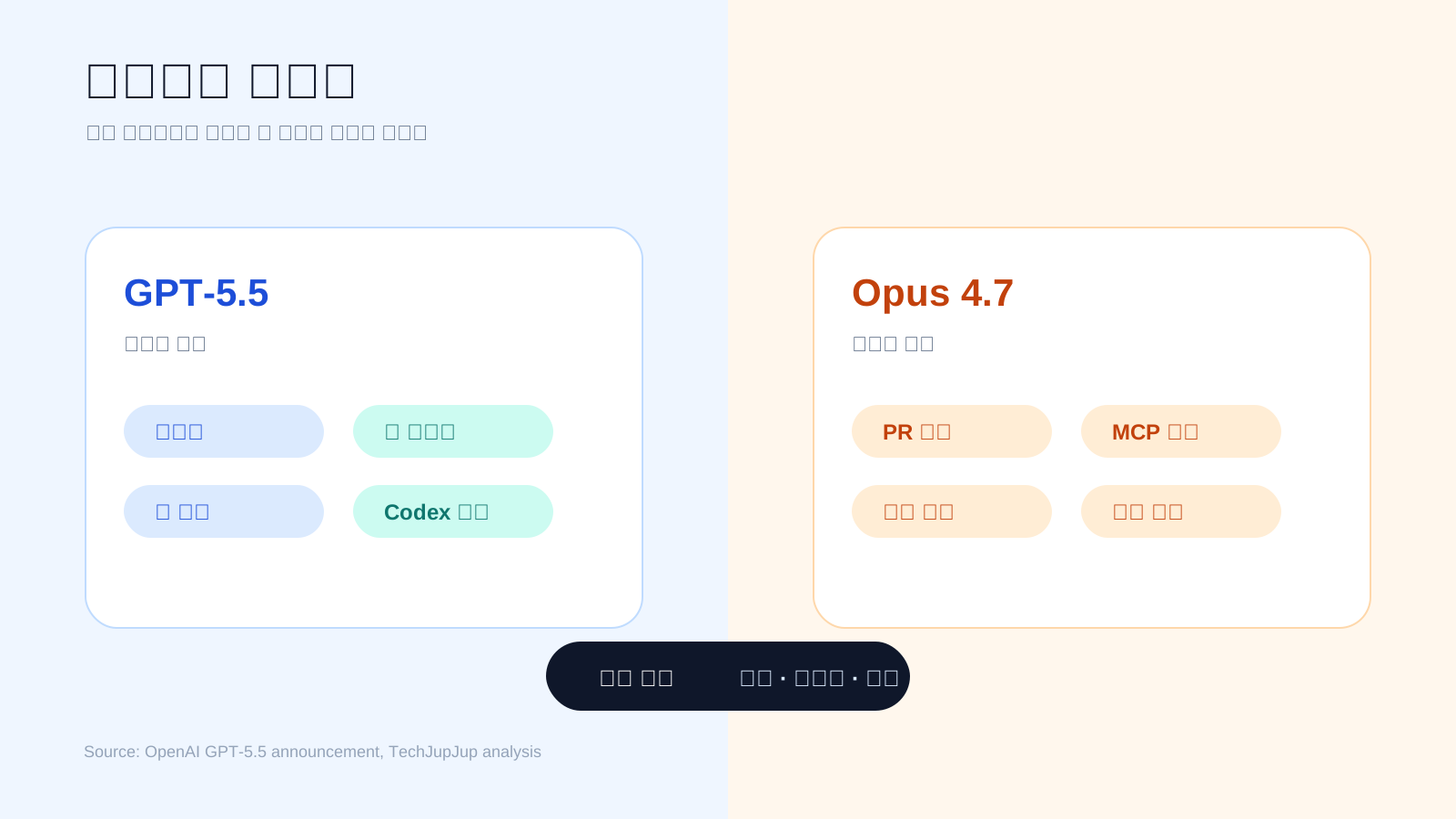
Points to look out for in the next comparison article
The next article will deal directly with “GPT-5.5 vs Claude Opus 4.7.” There are three key questions:
판단 기준
The three questions in the following comparison article
What is more important than the model name is which one completes the same task cheaper and more reliably.
Who completes the same coding task faster?
Rather than looking at the speed of the first response, you should look at the overall time it takes to pass the build.
Who has the lower cost per operation, not the token price?
Output tokens, retries, prompt cache, and human review times are calculated together.
Which is more stable: Codex or Claude Code?
We compare not only model performance, but also tool calls, file editing, test loops, and permission models.
Adding cheaper alternatives makes the situation more complicated. If budget is more important, you should also look at GLM 5.1 Review and Kimi K2.6 Complete Analysis.
What are the limitations and precautions?
GPT-5.5 is clearly stronger, but it also has dangerous misunderstandings. API access status, hallucinations, safe rejections, and differences between benchmarks and practice must be viewed separately.
APIs have different pricing and availability
The first thing to check is the API. OpenAI said that it will soon provide gpt-5.5 and gpt-5.5-pro to the Responses API and Chat Completions API, but it does not say “Any developer can use it right now” based on the release date (Source: OpenAI GPT-5.5 Announcement).
Among blogs and community posts, you can see posts written as if the API has already been opened. When planning commercial deployment, you should double-check the OpenAI pricing page and model page.
The hallucination rate indicator must be viewed dispassionately.
Artificial Analysis revealed that GPT-5.5 ranked first in the Intelligence Index by 3 points. At the same time, AA-Omniscience pointed out that although the accuracy is high, the hallucination rate is 86%, which is higher than 36% for Opus 4.7 Max and 50% for Gemini 3.1 Pro Preview (Source: Artificial Analysis).
These numbers are the result of specific benchmarks. This does not mean that you will hallucinate 86% of all knowledge questions. However, “The ability to say you don’t know what you don’t know” should be seen as a sign that it is still a task. When using GPT-5.5 as a research partner, it is essential to check sources, search for counterexamples, and verify links to the original text.
Safety guardrails can create friction
The OpenAI System Card summary explains that GPT-5.5 has undergone pre-deployment evaluations related to cybersecurity and biology, external red teams, and feedback from approximately 200 early access partners (Source: OpenAI GPT-5.5 System Card). The OpenAI announcement also treated cyber, biological and chemical capabilities as high based on the Preparedness Framework, and stated that a separate access path is provided to users for trusted defense purposes.
It’s not just a good thing. Teams working on defensive security may experience unnecessary rejection. The reason OpenAI has a separate access path called Trusted Access for Cyber is to reduce this friction. Therefore, when introducing GPT-5.5 for security purposes, not only model performance but also account trust signals, access rights, and audit logs must be designed together.
Which team should use it first?
The first teams to test GPT-5.5 are those with the “AI actually executes and verifies something” workflow. For simple chatbots, summaries, and short customer response, GPT-5.4 mini or existing models may be more reasonable.
Team to test first
If any of the following apply to you, GPT-5.5 is likely worth your while.
판단 기준
Team to test GPT-5.5 first
The key is whether AI only answers, or whether it handles execution, verification, and modification in one flow.
Team entrusted with implementation, refactoring, and testing with Codex
You can immediately check the long-term execution ability of GPT-5.5 in tasks that involve terminal commands and code modifications.
Team reading long logs and codebases together
It can be effective in tasks with long context, such as failure analysis, deployment logs, and large repo navigation.
Teams that want to bundle research, documents, and spreadsheets
It is suitable for teams that want to automate data research, table organizing, and document drafting in one flow.
Teams moving between terminals, browsers, and file systems
Automation for defense purposes must be designed with performance in mind, as well as access rights, audit logs, and rejection policies.
A team that can still wait
Conversely, the team below can move slowly.
판단 기준
A team that can still wait
If the advantages of GPT-5.5 are focused on long-term execution, a cheaper model may be appropriate for short and repetitive tasks.
Team mostly doing Q&A, translation, and summarization
If the output token is not significantly reduced, a doubling of the unit price can be felt as is.
Services with small budget and many output tokens
Services with high output, such as customer service, bulk summarization, and content creation, require cost experimentation first.
GPT-5.4 mini already has enough internal tools
If there is no quality bottleneck, prompt, cache, and routing optimization take precedence over model replacement.
Decision-making work without human verification
As hallucination and provenance issues remain, financial, legal, and security decisions must be left to the review stage.
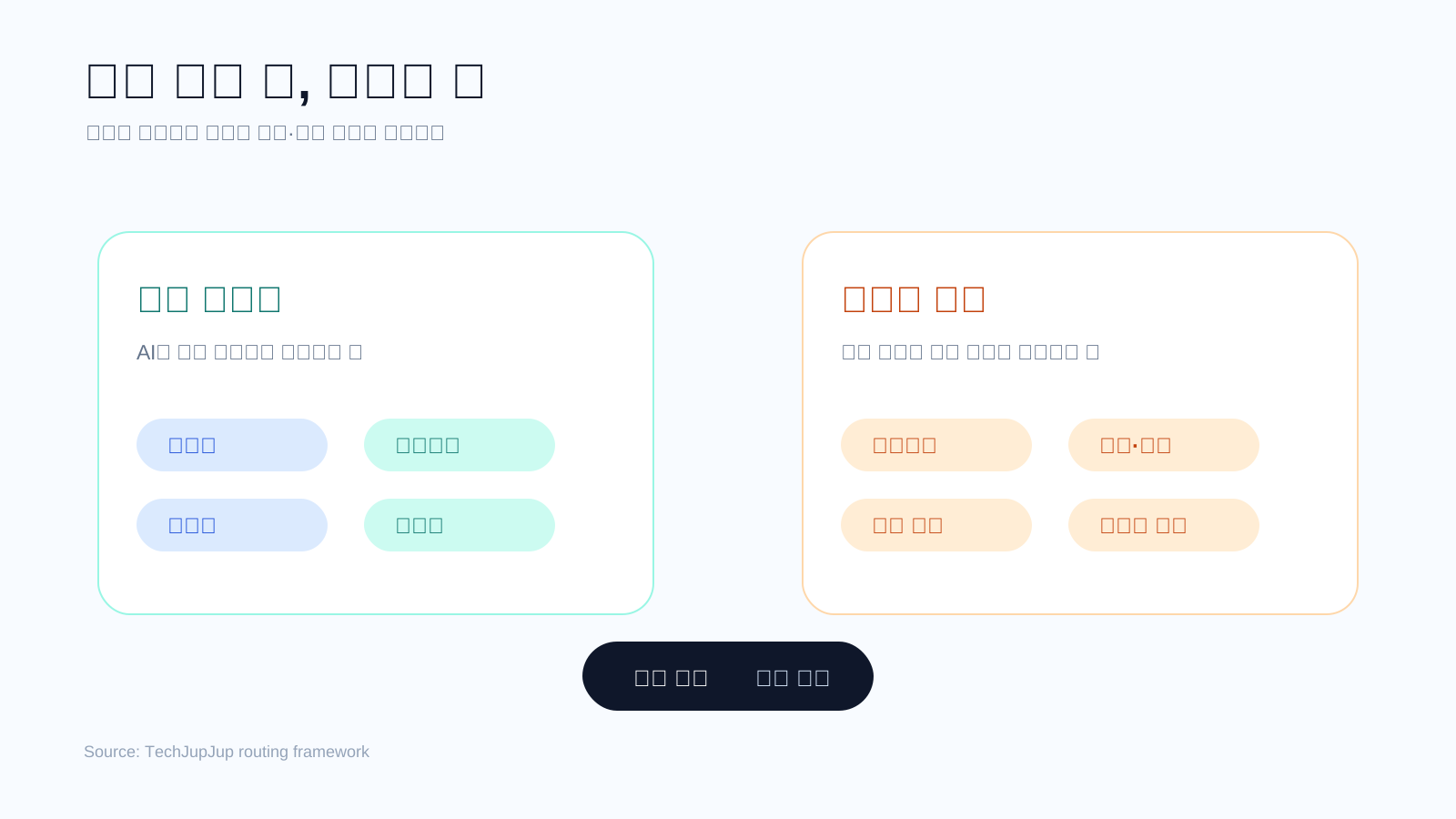
| work | Recommended Model | reason |
|---|---|---|
| Terminal-based debugging | GPT-5.5 | Terminal-Bench 2.0 strengths and long execution loops |
| PR unit code modification | Also tested with Opus 4.7 | Opus wins in SWE-Bench Pro |
| Long document/codebase research | GPT-5.5 | MRCR 512K-1M has significant improvement |
| High-volume, low-cost coding | GLM 5.1 / Kimi K2.6 Review | Cost savings compared to Frontier model |
| Accuracy-first single-shot analysis | GPT-5.5 Pro limited use | Output $180 so no abuse |
| Local/offline requests | Gemma Series Review | Reduce dependency on cloud APIs |
Order of introduction into practice
Collect existing logs
We sample more than 200 actual tasks processed with GPT-5.4 or Opus.
Compare cost per task
The input token, output token, number of retries, and final success rate are also recorded.
Create routing standards
A basic model is set for each task, such as GPT-5.5 for terminal work and Opus 4.7 for PR verification.
Leave a human review section
Research, security, finance, and legal work maintain human verification of sources and results.
FAQ: Frequently asked questions about GPT-5.5?
Can I use the GPT-5.5 API right now?
Can GPT-5.5 be used by free users?
Is GPT-5.5 better at coding than Claude Opus 4.7?
Has the price really doubled?
When should I use GPT-5.5 Pro?
Did GPT-5.5 reduce hallucinations?
Conclusion: Is GPT-5.5 worth using now?
GPT-5.5 is worth a try. It’s worth testing out right away, especially for codex, terminal automation, long context research, and working documentation. However, it should not be taken as “Beats Opus 4.7 in all coding” or “Even if the price is double, the actual cost is always the same.”
one sentence conclusion
GPT-5.5 is not a short-answer model, but a long-running business model. It’s strong in terminals and long contexts, and competes head-to-head with Opus 4.7 in SWE-Bench Pro and MCP tool calls.
Don’t turn GPT-5.5 into your entire base model in the first week, but stick to Codex’s terminal-based work and long-document research first. By recording results logs, token usage, number of retries, and human review times, you can turn “It feels good” into an actual adoption decision.
In the next article, we will compare GPT-5.5 and Claude Opus 4.7 head-to-head. The key ones are SWE-Bench Pro, Terminal-Bench, MCP Atlas, BrowseComp, Long Context, and Real Cost. The tentative conclusion at this stage is simple. GPT-5.5 is the strongest working model in the OpenAI ecosystem, and Opus 4.7 still has not easily given up the “Throne of Codebase Patches”.
Was this helpful?
One tap shapes what gets written next.
Topic tags

Andrej Karpathy's 4 AI Coding Warnings and the 100K-Star CLAUDE.md Repo
A deep dive into the four bad AI coding habits Karpathy warned about, the CLAUDE.md repo's four operating principles, what evidence supports them, and where the limits still are.
Read
GLM 5.1 Review: Run Claude Code at 1/5 the Price with Open-Weight SOTA
How to run GLM 5.1 in Claude Code at one-fifth the cost, plus what Z.AI's official docs reveal about subscription-backed API access, Vision MCP, and GLM-Image.
Read
Kimi K2.6 Deep Dive: 88% Cheaper Claude Opus 4.7 Alternative?
Kimi K2.6 is an open-weight MoE model with SWE-Bench Pro 58.6, HLE 54.0, 300-agent swarms, 256K context, and API pricing about 88% below Claude Opus 4.7.
Read